Recycling and deposit
Pfand
On this page
Sort household waste using your local collection guide: bin colours and collection days can vary. Where section 46 applies, the refundable deposit (Pfand) on a single-use drinks pack is at least 0.25 euro including VAT.
In short
- Use the separate collection your public waste authority provides for biowaste, plastic, metal, paper, glass, textiles, bulky waste, and hazardous waste. Bin colours and collection days are local. The textile duty applies from 1 January 2025.
- Where section 46 of the VerpackDG applies, the deposit on a single-use drinks pack is at least 0.25 euro including VAT. It is not refunded without the empty pack. The figure is a minimum, not a fine.
- Return the empty single-use pack to a qualifying seller, even if you bought it elsewhere. The return point is at that seller’s place of handover or nearby. The seller takes back material types it sells; a seller with a sales area under 200 square metres only has to take back brands it sells.
- Section 46(4) has volume and packaging exceptions, including specified cartons. Its beverage-category exceptions (such as milk or wine) do not apply to single-use plastic drinks bottles or cans. A 1L single-use plastic milk bottle is therefore not exempt merely because it contains milk.
Common bin colours
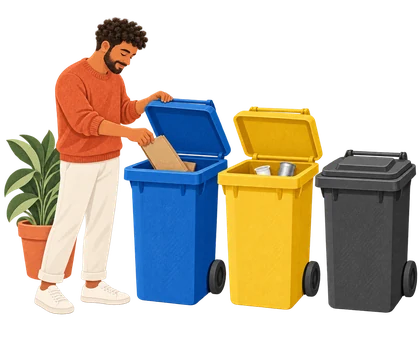
The illustration shows three familiar wheeled bins. These colours are examples: check the label and your local waste guide, as container and lid colours can differ and some places use yellow sacks.
- Blue — paper and cardboard: clean paper and flattened cardboard. Drinks cartons belong with lightweight packaging, not ordinary waste paper.
- Yellow — empty packaging: plastic yoghurt pots, food tins and other lightweight packaging. Empty them and separate detachable lids; rinsing is unnecessary. This is not automatically a bin for every plastic object.
- Black/grey — residual waste: non-recyclable household rubbish such as used tissues. Batteries, electrical items and hazardous waste need separate collection.
Organic waste and non-deposit glass packaging also need their own collection routes. These three bins are not the whole sorting system. Return deposit-bearing bottles and cans through the deposit system rather than putting them in these bins.
What you need to know
Section 20 of the Circular Economy Act requires public waste authorities to collect these materials separately from private households in their area when the waste is left with them: biowaste, plastic, metal, paper, glass, textiles, bulky waste and hazardous waste. The textile duty applies from 1 January 2025.
Bulky waste must be collected in a way that allows preparation for reuse and recycling of its parts. Hazardous waste must not be mixed with other waste during collection. Bin colours and collection days are local. With the competent authority’s approval, a waste authority can exclude waste covered by a take-back duty when take-back points actually exist.
The Federal Environment Agency says that on 12 August 2026 the Packaging Act was replaced by the Packaging Implementation Act, the Verpackungsrecht-Durchführungsgesetz, because Regulation (EU) 2025/40 on packaging and packaging waste applies directly from that date. The VerpackDG sets supplementary national rules, responsibilities, and procedure. The Agency also describes the deposit mark used on single-use drinks packs and the usual marks for refillable bottles. Old references to the repealed Packaging Act section on deposits are not the text to use.
Section 46 of the VerpackDG says the first distributor of single-use drinks packaging filled with a drink must charge purchasers a deposit of at least 0.25 euro including VAT per pack. Every later distributor charges it, down to the end buyer. The pack must be marked as deposit-bearing before it is made available in Germany.
Distributors take back empty packs at the place of handover or immediately nearby, during ordinary opening hours, free of charge, and refund the deposit. The deposit is not refunded without the return. The deposit-system operator says the original place of purchase does not determine the return point: an obliged seller takes back the material types it sells, and a seller with a sales area under 200 square metres only has to take back brands it sells.
Section 46(4) excludes, among other cases, packs under 0.1 litre and over 3.0 litres, listed carton and pouch formats, and listed categories of sparkling wine, wine, spirits, and milk drinks. Read that subsection before you assume a bottle has no deposit, and before you assume every bottle has one.
The beverage-category exceptions in section 46(4) do not apply to single-use plastic drinks bottles or drinks cans. For example, milk in a 1L single-use plastic bottle is not exempt merely because it is milk; the specified drinks-carton formats retain their separate packaging exemption. Volume and other statutory conditions still matter.
What to do
- Use the separate collection your public waste authority provides for biowaste, plastic, metal, paper, glass, textiles, bulky waste, and hazardous waste. Read the local calendar for the day and the bin. Do not copy another city’s colours.
- For a single-use drinks pack, look for the deposit mark. If section 46 applies, the deposit is at least 0.25 euro including VAT, and you get it back when you return the empty pack.
- Return the empty pack during opening hours to a seller that takes back that material, including a qualifying seller other than where you bought it. A shop under 200 square metres need not take a brand it does not sell. Refillable-container deposits follow different arrangements.
- Check the deposit mark, volume and packaging format. Milk in a single-use plastic bottle or a can is not exempt merely because of the drink; listed carton formats have a separate exception. Read section 46(4) for the complete conditions.
Common mistakes
- Treating bin colours as federal law. Section 20 lists materials, not colours or weekdays.
- Expecting a deposit refund without the empty pack. Section 46 says the deposit is not refunded without the return.
- Assuming every drinks carton carries 0.25 euro. Section 46(4) excludes listed carton formats and listed drinks.