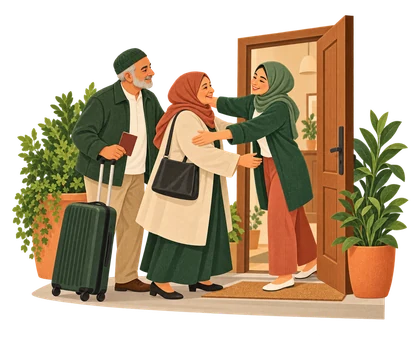
Family reunion
Familiennachzug

On this page
Family reunification (Familiennachzug) can allow family members to join each other and live together in Germany. Both spouses normally need to be at least 18, and the joining spouse generally needs basic German. Different exceptions apply to the age and language requirements.
In short
- Family reunification to a person with subsidiary protection is suspended until 23 July 2027 inclusive. Hardship cases under sections 22 and 23 remain possible. Section 29 (2) still requires livelihood and adequate housing to be waived for the spouse and minor unmarried child of a person with asylum or refugee protection when the application is filed within three months of final recognition and family life cannot be established in a non-EU state of special ties.
- First check free-movement rights, including for qualifying non-EU family members joining an EU/EEA citizen. Use the EU/EEA/Swiss guide for those rights and the separate Swiss agreement. A spouse who is an EU or EFTA citizen and joins you also follows the relevant free-movement rules, rather than this ordinary family permit.
- Both spouses normally must be at least 18, but section 30 provides a narrow exception and permits a hardship decision. Where section 30 requires simple German, the Federal Office for Migration and Refugees treats that as level A1, generally proved with the visa application before entry, unless a statutory exception applies. The language exceptions include a Blue Card and a set of skilled-worker titles; they do not all waive the age rule.
- The person you join must usually be able to support the family and cover health insurance. Joining a foreigner also normally requires adequate housing; section 29(5) waives that test for the spouses and minor unmarried children in its defined list. These rules do not set one national income or floor-area figure. The livelihood test is, as a rule, not applied to the spouse of a German. Section 30 does not give this permit to a further spouse while one spouse already lives with you in Germany.
- Section 32 covers a minor unmarried child. A child who has turned 18 is outside that rule. A child of 16 or older who is not moving their centre of life with those parents must also meet a language or integration condition, unless an exception applies.
- With a foreign sponsor on a temporary residence title, the family permit cannot run longer than that title; section 27(4) requires the same period in its listed cases. Otherwise the first grant is at least 1 year. For family of a German, section 28 provides for extension while family life continues. The fee follows federal law and any applicable reduction/exemption; the appointment procedure is local. This page states no universal amount. Register the address once there is a dwelling.
What you need to know
This guide covers the usual routes for spouses and minor children, as well as the parent-of-a-German-child case described below. It does not assess every humanitarian or protection case, other routes for parents or parents-in-law, or nationality-specific exceptions. A route not described here may still be available to you.
Before you act, use the Federal Foreign Office mission directory to contact the mission responsible for the joining person’s place of residence. After arrival, ask the responsible Ausländerbehörde which route, deadlines and documents apply to your family’s situation.
Section 27 says the permit to establish and keep family life is issued to protect marriage and the family. It is refused when the marriage or the family tie was created only so the person could enter and stay, or when there are real signs that a spouse was forced to marry.
EU, EEA, and Swiss citizens use the free-movement page, not this permit. A spouse who is themselves an EU or EFTA citizen and is joining you uses free movement as well. That spouse needs a valid identity document, not this title.
Section 30 covers a spouse joining a foreigner. Both spouses normally need to be at least 18. Neither the age nor the basic-German condition applies when the person in Germany has a permit under section 38a and the spouses already lived together as a married couple in the EU member state that granted that person long-term resident status.
Section 30(2) also permits an exception to the age condition to avoid particular hardship. The authority must assess the facts; the validity of the marriage and the other requirements remain separate questions.
The joining spouse normally needs to be able to communicate in basic German. The Federal Office for Migration and Refugees equates this with level A1 of the Common European Framework and says proof is normally filed with the visa application before entry.
The person already in Germany must hold one of the titles listed in section 30, including a settlement permit, an EU long-term residence permit or a Blue Card. The section also lists exceptions to the German requirement, including a Blue Card and certain skilled-worker titles, illness or disability, and efforts that are impossible or unreasonable before entry. Check the rule for the title involved in your case.
Section 28 uses the same basic-German rule for the spouse of a German, including A1 proof before entry where it applies, unless an exception applies.
The person you join usually needs to be able to support the family and cover health insurance. Under section 27, a permit can be refused if that person depends on basic social benefits for other family or household members. The law does not specify a national euro amount for this test; the Ausländerbehörde assesses your household’s circumstances.
For reunion to a foreigner, section 29(1), number 2 also normally requires adequate housing. Section 29(5) waives this for a spouse or minor unmarried child joining a holder of a Blue Card, ICT card, mobile ICT card, or a title under sections 18a, 18b, 18c(3), 18d, 18f, 19c(2), 19c(4), sentence 1, or 21.
It also covers section 19c(1) only for employment as a senior employee, executive, company specialist, scientist, visiting scientist, engineer or technician in a visiting scientist’s research team, or teacher.
Other status-specific exceptions must be checked with the authority. The Act does not set a single national floor-area figure; ask which housing evidence is needed for your case.
Section 29 (1), second sentence, waives adequate housing and waives the livelihood test in section 5 (1) number 1 except for sufficient health insurance, and section 27 (3) sentence 1 does not apply, when reunion is to an EU Blue Card holder who held an EU Blue Card issued by another Member State immediately before Germany issued the Blue Card, and the family already lived together in that Member State.
Section 28 is the family of a German living in Germany: the spouse, a minor unmarried child, and a parent with custody of a minor unmarried German child. The age and simple-German rules normally also apply to the spouses; section 28 applies the particular-hardship exception to the age rule. The livelihood test is, as a rule, not applied to that spouse.
Section 32 covers a minor unmarried child when both parents, or the parent with sole custody, hold a listed title. A child of 16 or older who is not moving their centre of life with those parents must also meet a language or integration condition, unless an exception applies. A parent’s Blue Card is one exception.
What to do
- Check who is joining whom and which residence title the person in Germany holds. Spouses, minor children and parents of a German child have different routes, so check which application fits your family.
- Ask the German mission responsible for the joining person’s current place of residence whether a visa is required before travel. Some nationalities may enter without a visa for family reunion and apply at the Ausländerbehörde afterwards. If a visa is needed, apply at the mission with the passport and any marriage or birth certificate it requests. Processing times vary.
- Check whether section 30 requires proof of basic German or an exception applies. Also check the requirements for livelihood and health cover and, when joining a foreigner, whether you need to show adequate housing or a legal exception applies.
- After arrival, register the address. Before the visa ends, apply to the Ausländerbehörde where you live. Ask that office whether the family permit allows work; do not start work on a visitor entry. Take the documents that office lists. A checklist from another city is only an example.
- With a foreign sponsor on a temporary residence title, the family permit cannot run longer than that title; section 27(4) requires the same period in its listed cases. Otherwise the first grant is at least 1 year. For family of a German, section 28 provides for extension while family life continues. Kita, school, and Elterngeld, if a child is part of the move, are separate pages. They do not replace this permit.
Separation or violence is a different question
If you experience separation or violence, a different residence route and specialist help may be available. This page does not assess whether you qualify or set out that route’s conditions or deadlines.
The Gewalt gegen Frauen helpline is available on 116 016. It offers free, anonymous and confidential telephone counselling around the clock, every day. It is for women of every nationality who are experiencing or have experienced violence, with or without a disability, as well as relatives, friends and professionals. The federal ministry’s help page says interpreters make telephone advice available in 18 other languages. On the counselling portal, instant chat is available only in German, daily from 12:00 to 20:00. Email counselling is also only in German, with a reply within 24 hours.
The ministry also lists a helpline for men on 0800 1239900, as well as chat and email. During its speaking times from Monday to Friday, men can contact advisers free and anonymously, in German and, where possible, English. The ministry page does not give exact hours or describe this line as available around the clock. Neither helpline decides residence applications; ask the Ausländerbehörde which route and evidence apply to you.
For a relative coming only temporarily, start with Visitor visas and sponsorship. The guest’s short-visit application and the host’s financial undertaking are separate from moving to live together. For the family-court workflow after a separation, use Separation and divorce; residence consequences need separate assessment.
Common mistakes
- Assuming the basic-German requirement is waived because someone else did not need it. The exceptions are listed in section 30, and a different residence title can still require basic German.
- Adding a second spouse while one spouse already lives with you in Germany. Section 30 says no further spouse then receives this permit.
- Treating a child who has turned 18 as still covered by the child rule. Section 32 is for a minor unmarried child.
- Forgetting the address registration because the family visa felt like the last step. The Anmeldung is still required once there is a dwelling, and the Ausländerbehörde will ask for the registered address.